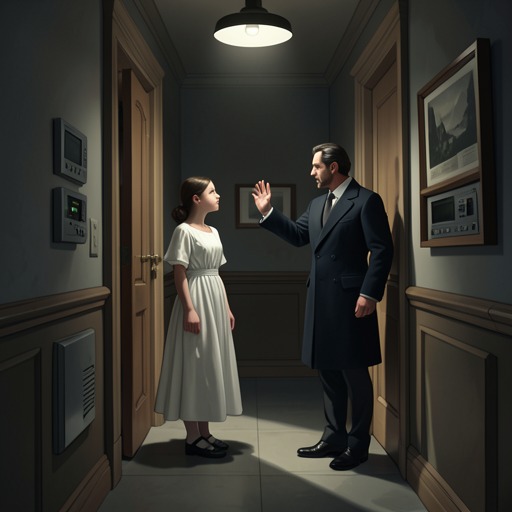
Leroy discovers the shoes and threatens Rhoda
The Bad SeedLeroy Jessup discovers the shoes and threatens Rhoda when he realizes that Rhoda Penmark’s attempt to destroy the footwear connected to Claude Daigle’s death has failed. His knowledge turns an overlooked pair of shoes into potential evidence and gives him leverage over her. The scene moves from taunting recollection to a specific account of how the shoes survived the incinerator, then to Rhoda’s uncharacteristically urgent demand that he return them.
Background and Stakes
The confrontation follows a brief stay away from town. During the visit, Rhoda behaved impeccably, and Christine Penmark began to feel some of her anxiety lift. The next afternoon, Rhoda returned to the familiar routine of crocheting beneath a pomegranate tree in the park. Leroy approached with a theory about the trip: he suspected that Rhoda had persuaded her mother to go to the bay so she could look for a stick. His suspicion links the outing to the effort to account for what happened to the evidence, although he soon shows that the stick is not what he believes was used against Claude Daigle.
Christine was watching Rhoda from a window. Rhoda did not look up or openly acknowledge Leroy; instead, she directed him to stand beside a bridal-wreath bush, outside her mother’s view. The quiet arrangement matters: their exchange takes place within Christine’s sightline but beyond her ability to hear or intervene. Rhoda’s attempt to manage the setting gives way to Leroy’s growing command of the conversation.
The wider stakes are already pressing on Christine. She has considered whether Rhoda might be insane and whether she should confess to the authorities, but she rejects the idea that Rhoda is insane. She also imagines the possibility of Rhoda being taken into an institution and fears the public attention a confession would bring. The problem, as Christine understands it, is not simply how to protect her daughter: it is what duty requires toward Rhoda and toward society. At this point, Kenneth Penmark does not yet know the full extent of the problem. Leroy’s discovery therefore introduces a threat that intensifies a crisis Christine has not resolved.
How Leroy Connects the Shoes to the Death
Leroy begins with a remembered detail: the heavy shoes Rhoda wore to the picnic made a distinctive tapping sound on the walk. He recalls having disliked that sound and having turned the hose on the shoes. His memory of the footwear leads him to notice that Rhoda has not worn them since. The detail is more than a recollection; it is the clue by which he starts testing his suspicion.
He then challenges Rhoda’s account of the weapon. Rather than immediately state what he believes happened, he first brings up a stick and waits for her to deny it. He explains that he had used the suggestion to unsettle her and make her identify the shoes herself. He now insists that Rhoda struck Claude Daigle with one of the shoes, whose iron cleats made it a plausible object of evidence. His account transforms his earlier teasing into a calculated attempt to draw out a response.
The scene does not present Leroy as having witnessed the attack. His knowledge comes instead from remembered sounds, Rhoda’s response to the false suggestion about a stick, and the shoes he says he recovered. The distinction gives the confrontation its particular tension: he is piecing together the connection while Rhoda tries to dismiss him, and each detail he supplies narrows her room to deny it.
The Incinerator and the Threat
Leroy claims that he found a key to the front door while Rhoda and Christine were away at the hotel. He says he entered their apartment, searched it, and took the shoes. When Rhoda answers that she put them in the incinerator and burned them, Leroy reveals why he believes she has mistaken destruction for success.
He says he was resting in the basement when he heard something rattle down the incinerator pipe. Opening the door, he found the shoes on top of the coals, only partly scorched. He claims enough remained for their connection to the crime to be demonstrated. The apartment building incinerator, which Rhoda believed had erased the evidence, has instead become the source of Leroy’s leverage: he says he possesses the shoes and knows where they are hidden.
Leroy threatens to hand them to the police and tell them to look for Claude Daigle’s blood. He frames the threat as a way to make Rhoda obey him, demanding that she treat him well and do what he says. His conduct is therefore not merely the disclosure of a discovery. He converts the evidence into a means of control, presenting himself as the person who can expose her while making clear that he intends to keep the shoes for his own purposes.
Rhoda’s Response and the Scene’s Reversal
At first Rhoda denies that Leroy has the shoes and says he is lying. His account of hearing them come down the pipe changes her response. She sets aside her needlework, watches him, and asks him to return them. The shift is decisive: she no longer treats his accusation as empty provocation. Her request confirms the importance of the evidence without amounting to an admission of the killing.
Leroy refuses. He says he will keep the shoes so that Rhoda will behave better, and his amusement at the arrangement soon falters. Rhoda follows him and repeats her demand. When he continues to withhold them, something in her fixed, cold stare makes his laughter die away; he looks down uneasily at his own shoes and breaks off mid-sentence. He gets up and walks away nervously. The exchange thus reverses its apparent balance: Leroy has the material evidence and has been enjoying his power over Rhoda, but her persistent, controlled response makes him uneasy.
The episode sharpens the novel’s conflict between concealment and accountability through concrete objects and actions. The remembered tapping sound identifies the footwear; the incinerator fails to destroy it; Leroy’s claim to possess it brings the threat of the police into Rhoda’s private world. For Christine, whose thoughts already circle around confession and responsibility, this discovery makes the danger of keeping the secret more immediate. For Rhoda, the scene shows how quickly her composed denial can give way to focused insistence when the evidence she thought destroyed is placed beyond her control.